
California DMV Permit Practice Test 9
- Questions36
- Correct to pass30
- Passing score83%
- Minimum age15 years 6 months
-
1. A yellow lamp flashes above a warning sign at a sharp curve. What does it ask of a driver?
Show answer
Answer D: Slow down and pass the point with extra care
A warning beacon draws attention to the sign it is mounted with, and the message of the sign is what the driver must act on.
-
2. You are driving through a neighborhood where several children are riding bicycles. What should you do?
Show answer
Answer C: Slow down and expect sudden, unpredictable moves
Young riders lack the judgment and the mirror habits of adults and may swerve or cross without looking, so lower speed is your only reliable margin.
-
3. In normal operation, which indication always comes between a green and a red on the same signal face?
Show answer
Answer C: A steady yellow
The yellow change interval must follow every green or green arrow, so a signal can never jump straight from green to red.
-
4. You are parking facing uphill on a street with a curb. What is the correct wheel position?
Show answer
Answer B: Turn the front wheels away from the curb and let the vehicle roll back until a tire touches it
Facing uphill the vehicle would roll backward, so the wheels point away from the curb and the tire is rested against it to act as a block.
-
5. Your brake pedal sinks to the floor and the vehicle does not slow down. What is a reasonable sequence of actions?
Show answer
Answer C: Pump the pedal, shift to a lower gear and apply the parking brake gradually while steering to a safe spot
Pumping can rebuild pressure in a partly failed system, a lower gear adds engine braking, and easing on the parking brake slows the vehicle without locking the wheels.
-
6. A freeway sign reads BUSES ONLY ON SHOULDER 6 AM TO 9 AM. Who may drive on the shoulder then?
Show answer
Answer A: Only the vehicles named on the sign, during the hours shown
Shoulder running is granted by the sign to the class of vehicle and the hours the sign names, and it does not turn the shoulder into a general travel lane.
-
7. Why is standing water across a road dangerous even when it looks shallow?
Show answer
Answer B: It can hide a washed out roadbed, a deep hole or a missing cover
You cannot see the surface under the water, and floods commonly wash the roadbed away or lift covers off drains.
-
8. Where should the lap part of the seat belt sit?
Show answer
Answer C: Low and snug across the hips, touching the tops of both of the thighs
The hip bones can take crash forces, but the abdomen cannot, so the lap belt goes low and tight across the hips.
-
9. What is the recommended minimum distance between the driver's breastbone and the center of the steering wheel air bag cover?
Show answer
Answer C: About 10 inches
An air bag inflates extremely fast, and keeping that much space lets it deploy fully before it reaches the driver, which is why the seat should be moved back as far as still allows comfortable control of the pedals.
-
10. Where are signs of this kind placed at an intersection?
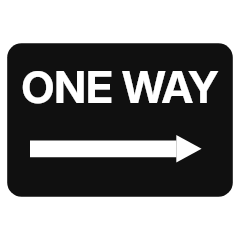
Show answer
Answer C: At the near right and far left corners, facing drivers on the intersecting street
They are installed at the corners of the intersecting street so that a driver about to turn in sees the restriction before committing to the turn.
-
11. As a general rule, how far should you travel along a center two-way left-turn lane before you turn?
Show answer
Answer C: Only a short distance, just enough to slow down and wait for a gap
The center lane is for making or preparing a left turn, so you enter it only shortly before the turn and never travel along it as a through lane; several states set a specific limit such as 200 or 300 feet.
-
12. What does California law allow a driver under 18 to do with a cell phone while driving?
Show answer
Answer A: Only make an emergency call
California bars minors from using a cell phone or electronic wireless device to answer calls or send messages, allowing only calls for emergency purposes.
-
13. A short driver cannot get ten inches between the chest and the steering wheel airbag. What is the answer?
Show answer
Answer D: Move the seat back and tilt the wheel downward, or fit pedal extenders
Distance from the airbag is gained by moving the seat back and aiming the wheel at the chest, using pedal extenders if the pedals are then out of reach.
-
14. You have just passed a vehicle on a two-lane road. When may you return to your lane?
Show answer
Answer B: When you can see the whole vehicle in your inside mirror
Seeing the entire vehicle you passed in your rearview mirror shows there is room to pull back in without cutting it off.
-
15. You are approaching a traffic light that has been green for a long time. How should you treat it?
Show answer
Answer C: Expect it to change and be ready to stop
A light that has been green for a while is called a stale green light. Cover the brake and decide in advance where you could still stop safely.
-
16. What does a blood alcohol concentration of 0.08 mean for the driver of a car?
Show answer
Answer B: It is the level almost every state treats as legally intoxicated
In almost every state a driver at 0.08 or above is legally intoxicated whatever the driver seems like, but impairment starts well before that level is reached.
-
17. What is required to use a rental car for a California behind-the-wheel drive test?
Show answer
Answer C: Your name on the rental contract, which must not exclude drive tests
If you use a rental vehicle, your name must be on the rental contract and the contract must not exclude behind-the-wheel drive tests.
-
18. You have strapped luggage to the roof rack for a long trip. What should you expect?
Show answer
Answer D: A higher center of gravity, so take the curves and lane changes gently
Weight on the roof raises the center of gravity and makes the vehicle lean and respond more slowly to steering.
-
19. What is the proper use of the horn?
Show answer
Answer C: To give a brief warning when another road user may not have seen you
The horn is a warning device meant to alert someone to your presence when a collision is possible, and using it in anger tends to escalate conflict rather than prevent crashes.
-
20. What is the maximum fine in California for riding a bicycle on a highway while under the influence?
Show answer
Answer B: $250
Section 21200.5 makes riding a bicycle under the influence of alcohol or a drug unlawful and sets a maximum fine of $250.
-
21. You are traveling at 55 mph on a rural road and come up behind a horse-drawn buggy. What is the main danger?
Show answer
Answer D: You close on it very quickly because it moves at walking pace
A buggy travels only a few miles an hour, so the gap closes far faster than drivers expect and there is very little time to brake once you see it.
-
22. The electric windows will not work as your vehicle sinks in water. What is the best option?
Show answer
Answer C: Break a side window with a hard, pointed object and climb out through it
Side windows are tempered glass and can be broken, while the laminated windshield cannot, and water pressure holds the doors shut.
-
23. You are turning left at an intersection just beyond the crest of a hill. What is the added risk?
Show answer
Answer B: Oncoming vehicles appear with very little warning and close quickly
A crest hides approaching traffic until it is close, so the gap you thought was empty can fill in the time the turn takes.
-
24. A signal stands part way up a freeway entrance ramp and turns green briefly again and again. How many vehicles does such a signal normally release on each green?
Show answer
Answer A: One for each lane of the ramp
A ramp control signal releases a single vehicle per lane on each green so that vehicles reach the merge one at a time instead of in a bunch.
-
25. A city transit bus ahead of you has stopped at the curb with its passenger door open. What does the law require of you?
Show answer
Answer D: Nothing special, but pass slowly and watch for people
The mandatory stop applies to a school bus showing red flashing lights, not to a transit bus, though a careful driver still slows for crossing passengers.
-
26. What is the California speed limit at a blind intersection and in an alley?
Show answer
Answer B: 15 mph
California sets 15 mph both at blind intersections, meaning intersections with no stop signs at any corner, and in alleys.
-
27. How does a NO OUTLET sign differ from a DEAD END sign?
Show answer
Answer B: It warns that a whole group of streets has no way out
No Outlet is posted where the road leads into a network of streets from which there is no through route, while Dead End refers to the single street itself.
-
28. What does California impose for a second refusal of a chemical test within 10 years of a prior DUI incident?
Show answer
Answer D: A two-year revocation of the driving privilege
Section 23612 turns a second refusal within 10 years into a two-year revocation, and a third or later refusal into a three-year revocation.
-
29. Which of these is part of preparing a vehicle for winter driving?
Show answer
Answer A: Fitting good tires and using washer fluid that will not freeze
Winter readiness means tread, battery, wipers, antifreeze and washer fluid rated for the cold, plus a reasonable amount of fuel in the tank.
-
30. Besides the traffic behind you, what else must you check before moving into the next lane?
Show answer
Answer D: That there is room ahead in the new lane for your normal following distance
Moving into a gap that is too short leaves you tailgating the vehicle ahead with a vehicle close behind you.
-
31. You leave a brightly lit service area onto a dark rural road. Why should you slow down for a while?
Show answer
Answer C: Your eyes need time to adjust, so at first you see less
Eyes take a few minutes to adapt from bright light to darkness, and during that time you can see much less than your headlights actually show.
-
32. What does a posted speed limit sign represent?
Show answer
Answer B: The maximum speed permitted under ideal conditions
A speed limit is an upper limit that assumes good weather, good visibility and light traffic, so the safe speed is often lower than the posted figure.
-
33. Your light is green but the traffic beyond the intersection is stopped and there is no room on the far side. What should you do?
Show answer
Answer A: Wait behind the line until you can clear the far side
Entering an intersection you cannot clear blocks the cross traffic when their signal turns green, so you wait behind the line.
-
34. A driver slows to walking pace at this sign, never stops rolling and eases into the intersection. How is that treated?

Show answer
Answer B: It is a violation, because the vehicle never came to a complete halt
What is required is a full halt with the wheels no longer turning, so slowing down, however carefully, does not satisfy it.
-
35. In near freezing weather, which part of an otherwise clear road is most likely to still be icy?
Show answer
Answer D: A shaded dip under trees or beside a rock cut
Sun clears most of the road, but shaded hollows never warm up and can hold ice long after the rest of the pavement is dry.
-
36. You decide to turn around using a driveway on your right. What is the safer way to do it?
Show answer
Answer C: Stop past the driveway, reverse into it, then pull out and drive away
Passing the driveway and backing in means you reverse off the roadway and then rejoin traffic facing forward, with a full view of both directions.