
California DMV Motorcycle Practice Test 19
- Questions25
- Correct to pass20
- Passing score80%
- Minimum age15 years 6 months
-
1. Why may the mirrors and the headlight need readjusting when a passenger is carried?
Show answer
Answer D: Because the added weight changes the angle at which the motorcycle sits
Weight on the rear of the motorcycle raises the front, which aims the headlight and the mirrors higher than the rider intends.
-
2. A steady red arrow is displayed for your left-turn lane at a two-way intersection. What must you do?
Show answer
Answer C: Stop and remain stopped until an indication permits the turn
A steady red arrow prohibits the movement it points to, so the driver stops and waits for a green arrow, a flashing yellow arrow or another indication that permits the turn.
-
3. What type of violation is failing to obey California's move over law?
Show answer
Answer D: An infraction punishable by a fine
The commercial driver handbook states that in California failing to obey the move-over law is an infraction punishable by a fine.
-
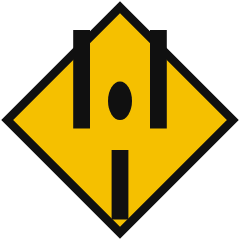
4. What change in the road does this sign announce?
Show answer
Answer B: The two directions of travel are about to be separated, and the driver must keep to the right of the separation
Ahead the roadway splits into separate one-way roadways on either side of a median, so the driver stays to the right of the divider and no longer meets oncoming vehicles.
-
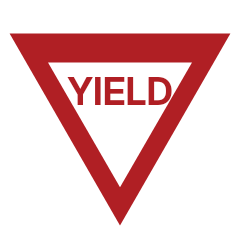
5. Apart from other vehicles, who else must a driver let go first at this sign?
Show answer
Answer A: Pedestrians and cyclists already in or entering the crossing
The duty to give way covers every road user who has the right of way at that point, including people walking or cycling across the driver's path.
-
6. Your motorcycle starts to wander while you ride over rain grooves or a bridge grating. What should you do?
Show answer
Answer A: Relax, hold a steady speed and ride straight across
The wandering feeling on grooved surfaces and gratings is unsettling but generally not hazardous, while zigzagging to fight it is far more dangerous.
-
7. How should you use your mirrors while another vehicle overtakes you on a multilane road?
Show answer
Answer C: Follow it from the inside mirror to the side mirror and then to your own view
Handing the vehicle from one mirror to the next keeps it in sight through the blind spot instead of losing it there.
-
8. You are approaching an uncontrolled intersection on a residential street where parked cars hide the cross street. What is the correct approach?
Show answer
Answer B: Slow enough to stop and creep out until you can see
Without a sign or signal you still have to be able to yield, and you cannot yield to traffic you have not seen.
-
9. You have tied a load down with cords that are longer than you need. What should you do with the loose ends?
Show answer
Answer D: Secure the loose ends so nothing can reach the chain, the wheel or the road
A dangling cord can be caught by the rear wheel or the chain and jam it, which can lock the wheel without any warning to the rider.
-
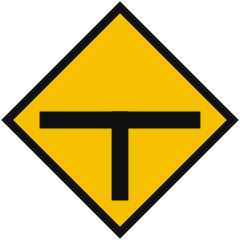
10. What must a driver be prepared to do at the point this sign refers to?
Show answer
Answer D: Turn left or right, because the road being traveled ends there
The road ends at another roadway, so the driver must slow, give way to traffic on the through road and turn in one direction or the other.
-
11. How often should you check your mirrors while driving?
Show answer
Answer C: Every few seconds, so you always know what is around you
Traffic behind and beside you changes constantly. Frequent, brief mirror checks keep a picture of your surroundings current so nothing surprises you.
-
12. Windblown sand has collected across the pavement at a rural intersection where you must stop. How should you handle the stop?
Show answer
Answer A: Do your braking on clean pavement before the sand, then roll across upright
Sand acts like ball bearings under the tires, so finish your braking on the clean surface ahead of it and cross the loose patch upright with no sudden inputs.
-
13. A car in the lane to your left keeps drifting toward the line between you. Which portion of your lane should you move to?
Show answer
Answer A: The right portion
Moving to the far side of your lane buys distance and time if that driver keeps coming, and it may also make the motorcycle visible to a driver who had not noticed it.
-
14. A sign at the intersection prohibits U-turns, but the opening looks wide and clear. What may you do?
Show answer
Answer B: Obey the sign and turn around somewhere else
A prohibition applies whatever the traffic looks like at that moment, usually because of sight distance or conflicts you cannot see from the lane.
-
15. How may a California driver show evidence of financial responsibility when a peace officer asks for it?
Show answer
Answer A: On a mobile electronic device, which the officer may not otherwise browse
Section 16028 lets the driver present evidence of financial responsibility on a mobile electronic device, and bars the officer from viewing any other content on that device.
-
16. What should a rider remember about convex mirrors?
Show answer
Answer B: They show a wider view, but vehicles look farther away and slower than they are
The curved glass fits more of the scene into the mirror, and the price of that extra width is a distorted sense of distance and closing speed.
-
17. What is a good rule for any task you want to do inside the vehicle?
Show answer
Answer D: If it needs more than a moment, do it stopped
A glance of a second or two is manageable, but any task that runs longer belongs to a stopped vehicle, because the road does not pause while you do it.
-
18. Why are sign shapes and colors standardized across the whole country?
Show answer
Answer D: So a driver knows the kind of message before reading it
Uniform shapes and colors let a driver classify a sign as regulatory, warning or guide from a distance, before the legend can be read.
-
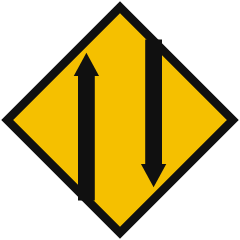
19. What is a driver being warned about here?
Show answer
Answer B: The pavement ahead carries vehicles traveling in the opposite direction
Beyond this point vehicles come the other way on the same pavement, which commonly happens where a one-way section or a separated stretch comes to an end.
-
20. When should a helmet be replaced?
Show answer
Answer B: After a crash, or if the shell is cracked or the straps are frayed
The energy absorbing liner is designed to crush once, so a helmet that has taken an impact or shows damage no longer offers full protection.
-
21. What do zero tolerance laws mean for a driver who is under 21?
Show answer
Answer B: They commit a violation at an alcohol level far below the adult limit
Drivers under 21 may not legally drink, so every state sets a limit far below the adult one and treats even a trace reading as a violation. The exact figure is set by each state, and the penalty usually includes losing the license.
-
22. Why is parking against the flow of traffic dangerous even when nobody complains?
Show answer
Answer D: Because you had to cross traffic to get there and must cross again to leave
Parking on the wrong side means driving against traffic at both ends of the stop, and your reflectors and lights face the wrong way while you are there.
-
23. A sign with a green background and a white legend normally provides
Show answer
Answer A: directions, distances and destinations
Green is the background color of the guide sign series, which names routes and destinations and gives the distance to them.
-
24. A person in a wheelchair is traveling in the roadway because the sidewalk is blocked by construction. What should you do?
Show answer
Answer B: Pass slowly with plenty of room, or wait
A blocked sidewalk leaves the person no choice but the road, and a chair cannot move aside quickly, so pass wide and slow or wait for room.
-
25. Will California DMV waive the motorcycle skills test based on an out-of-state motorcycle training course?
Show answer
Answer B: No, only a California CMSP course with a DL 389 can waive it
DMV will not waive the skills test based on an out-of-state training program or a course completion card for insurance purposes.