
California DMV Motorcycle Practice Test 36
- Questions25
- Correct to pass20
- Passing score80%
- Minimum age15 years 6 months
-
1. In most states, when are headlights required apart from times of poor visibility?
Show answer
Answer A: From about half an hour after sunset to half an hour before sunrise
Most states require lights from about half an hour after sunset until about half an hour before sunrise, and some simply say sunset to sunrise; lights are also required whenever visibility is poor.
-
2. You are driving on a divided highway and see a solid yellow line along the left side of your lanes. What does it tell you?
Show answer
Answer D: It marks the left edge of the roadway for your direction
On a divided highway or a one-way roadway, the left edge of the traveled way is marked with a solid yellow line.
-
3. Driving at night you notice that the raised markers along the line beside you are throwing back red light. What does that tell you?
Show answer
Answer C: You are facing traffic and must get off that roadway
Red retroreflection is shown only toward traffic that should not be there, so a red return means the vehicle is heading the wrong way.
-
4. In most states, how far before a turn must your signal already be on in city traffic?
Show answer
Answer B: At least 100 feet, roughly the length of six or seven cars
Most states require the signal for at least 100 feet before a turn in city driving, which gives drivers behind you time to react before you slow; several require more at higher speeds.
-
5. How can you tell a tire has reached its wear limit without measuring it?
Show answer
Answer C: The wear bars across the grooves become level with the tread
Molded bars sit at the bottom of the grooves. Once the surrounding tread has worn down to them, the tire has reached the end of its safe life.
-
6. You are about to leave a roundabout when a pedestrian steps into the crosswalk on your exit. What should you do?
Show answer
Answer B: Yield to the pedestrian and wait for the crosswalk to clear
Roundabout crosswalks sit on the entries and exits, and drivers must yield to pedestrians using them.
-
7. The circular sign shape is reserved for which warning?
Show answer
Answer C: Advance warning of a highway-rail grade crossing
A round yellow sign with a black X and the letters RR is the grade crossing advance warning sign, and the circular outline is used for no other message.
-
8. Oil is visible running down the front fork tubes. What does that mean?
Show answer
Answer C: A fork seal has failed and the suspension needs repair
Fork oil escaping past a seal means the front suspension is losing its damping, and the oil can also reach the front brake and ruin its grip.
-
9. A signal on an entrance ramp changes from red to green and lets one vehicle at a time onto the highway. What should you do?
Show answer
Answer A: Stop on the red and go on the green, one vehicle for each green
A ramp meter spaces vehicles out so they join the highway one at a time instead of arriving as a group, and it is a traffic signal like any other.
-
10. This sign leads to a crossing that has no gates and no flashing lights. What does that mean for the driver?
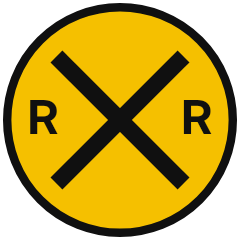
Show answer
Answer D: Nothing will warn of an approaching train, so the driver must check the tracks personally
At a passive crossing there is no active device to announce a train, so the whole judgment rests on the driver, who must approach slowly enough to stop after looking along the track.
-
11. A rider needs to stop quickly while leaned over in a curve. What is the best technique?
Show answer
Answer D: Bring the motorcycle upright where possible, then brake firmly with both brakes
An upright tire has more traction available for braking, so lean angle should be reduced as brake pressure is increased.
-
12. A large X with the letters R and R beside it is painted across your lane. What does it mean?
Show answer
Answer A: A railroad crossing lies a short distance ahead
The pavement marking repeats the advance warning for a grade crossing, and it is used on paved approaches where speeds are high or where gates are installed.
-
13. At a railroad crossing with no gates and no flashing lights, the crossbuck is normally combined with which sign?
Show answer
Answer C: A yield sign, or a stop sign where an engineering study calls for one
At a passive crossing the crossbuck forms an assembly with a yield sign, or with a stop sign when an engineering study or engineering judgment supports it, so the driver knows who must give way to the train.
-
14. How long is a California Certificate of Completion of Motorcycle Training, form DL 389, valid?
Show answer
Answer A: 12 months from the issue date
California accepts the DL 389 for 12 months from the issue date, and the DMV will not waive the motorcycle skills test on the basis of an out-of-state training program.
-
15. You are waiting to turn and the traffic ahead has stopped. Where must you not come to rest?
Show answer
Answer D: On the crosswalk, which people need in order to cross the street
Stopping on a crosswalk forces pedestrians out into the traffic lanes to get around you, so you hold back before it instead.
-
16. You are approaching a driveway where a car waits to pull out and the driver is looking your way. What should you assume?
Show answer
Answer D: The driver may not have seen you, so cover the brakes and be ready to slow
Looking in your direction is not proof that a driver has registered a motorcycle, so cover the brakes and be ready to slow until the car is clearly staying put.
-
17. Your motorcycle has a grab rail behind the passenger seat. What should the passenger know about using it?
Show answer
Answer C: It is fine to hold, but they must still brace against acceleration
A rail behind the passenger gives a secure grip but does nothing to stop them sliding backward, so they still need to expect the machine to pull away.
-
18. Why is reflective material more useful than bright color once it is dark?
Show answer
Answer C: It throws headlight light back toward the driver, while color goes unseen
Color needs daylight to be seen, while reflective material returns the beam of an approaching vehicle straight back to its driver.
-
19. A rider chooses an open face helmet. What does that choice make necessary?
Show answer
Answer A: Separate goggles or a face shield, because the face is uncovered
An open face helmet gives no eye or face protection, so the rider must add goggles or a face shield that will not shatter and that seals against the wind.
-
20. You are stopped at an intersection where bushes block your view of cross traffic. What should you do?
Show answer
Answer A: Edge forward slowly until you can see, then proceed when clear
Creeping forward a little at a time lets you gain a view without committing to the crossing. Never enter an intersection you cannot see into.
-
21. How long does a California driver have to contact DMV after receiving a Notice of Priority Reexamination?
Show answer
Answer C: Five working days, or the privilege is automatically suspended
A driver who receives a Notice of Priority Reexamination with the top box checked has five working days to contact DMV or the driving privilege is automatically suspended.
-
22. A minor drop has left the clutch lever bent, although it still works. What should be done?
Show answer
Answer B: Have the lever replaced before the motorcycle is ridden again
A bent lever has already been weakened and can break off in use, leaving the rider without that control at the worst possible moment.
-
23. You are approaching a highway-rail grade crossing marked only with a crossbuck sign. What does that sign require?
Show answer
Answer A: Yield to any approaching train and cross only when the tracks are clear
The crossbuck is a regulatory yield sign, and a train can never stop or steer around a vehicle, so the driver must always give way.
-
24. What is the recommended way to park a motorcycle at a curb?
Show answer
Answer C: At an angle, with the rear wheel touching the curb
Backing the rear wheel to the curb at an angle keeps the motorcycle clear of traffic and lets the rider ride out forward instead of backing into the lane.
-
25. A driver reaching a stop sign is required to do what?
Show answer
Answer D: Come to a complete stop and then proceed only when it is safe
A stop sign requires a full stop before the stop line, crosswalk or intersection, after which the driver may go on once the way is clear.