
California DMV Motorcycle Practice Test 45
- Questions25
- Correct to pass20
- Passing score80%
- Minimum age15 years 6 months
-
1. You find yourself in a lane that must turn, you wanted to go straight, and you cannot change lanes safely. What should you do?
Show answer
Answer D: Make the required turn and find another route
Going straight from a mandatory turn lane surprises everyone around you, while a wrong turn costs only a few extra minutes.
-
2. At 45 mph you look at a navigation screen for four seconds. Roughly how far do you travel unseeing?
Show answer
Answer D: About 260 feet
At 45 mph you cover roughly 66 feet a second, so four seconds on a screen is around 260 feet of road that you never looked at.
-
3. The only person offering you a ride home has been drinking. What should you do?
Show answer
Answer B: Do not get in; find another way home
A passenger in an impaired driver's vehicle shares all of the risk and can do nothing about it from the seat, so the only safe answer is another ride.
-
4. You come upon a person riding a horse on the roadway ahead of you. What is the correct way to pass?
Show answer
Answer A: Slow down, give plenty of room and do not use the horn
Horses startle easily, and a frightened horse can throw its rider into your path. Pass slowly and wide, and avoid any sudden noise.
-
5. You are about to slow down sharply for a turn. Which check comes first?
Show answer
Answer A: A look in the mirror to see how close the traffic behind you is
Any hard slowing needs a mirror check first, because the driver behind is the one who has to react to it.
-
6. In California, what blood alcohol concentration makes it illegal to drive for a person over 21?
Show answer
Answer D: 0.08 percent or higher
California prohibits driving with a blood alcohol concentration of 0.08 percent or higher for drivers over 21 years old.
-
7. You are stopping for a red light in the rain and your stopping point is on a wide painted stop line and crosswalk. What should you do?
Show answer
Answer C: Slow earlier and gently, since wet paint offers much less grip than pavement
Painted stop lines and crosswalks turn slick when wet, so start braking early and squeeze gently rather than braking hard on the markings.
-
8. A deer has just crossed in front of you on a stretch signed for animal crossings. What is the best assumption?
Show answer
Answer B: More animals are likely to follow the first one
Deer travel in groups, so one animal crossing usually means others are about to follow, and a driver should slow and keep scanning both shoulders.
-
9. The signal turns green as you approach an intersection. What is the safest practice?
Show answer
Answer B: Look left, then right, then left again, and make sure the intersection is clear before entering
A green light gives permission but does not guarantee the intersection is empty, and a quick scan catches a vehicle running the red or a pedestrian still crossing.
-
10. Which sequence describes a well-made turn?
Show answer
Answer A: Signal, move into the correct lane, slow down, check, then turn
Tell others first, take your position, lose the speed before the corner, take a final look, and only then steer through the turn.
-
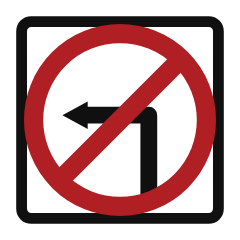
11. A driver in the leftmost lane reaches this sign at an intersection. What must the driver do?
Show answer
Answer B: Go straight on or turn right, and reach the destination another way
The restriction holds whatever the traffic or the signal is doing, so the driver has to pass the intersection and plan a different route.
-
12. You park at the roadside on a hill, facing downhill. What keeps the motorcycle from rolling away?
Show answer
Answer D: Leaving it in first gear with the front wheel turned toward the curb
A motorcycle has no parking brake, so the transmission left in gear stops the wheel turning and the front wheel turned into the curb blocks any roll.
-
13. What does a shaft final drive need checked before a ride?
Show answer
Answer D: The fluid level in the final drive housing, and any sign of leaks
A shaft drive runs in its own oil bath, so the pre-ride check is the fluid level and any leak around the housing seals rather than tension or slack.
-
14. A signal stands part way up a freeway entrance ramp and turns green briefly again and again. How many vehicles does such a signal normally release on each green?
Show answer
Answer A: One for each lane of the ramp
A ramp control signal releases a single vehicle per lane on each green so that vehicles reach the merge one at a time instead of in a bunch.
-
15. How should following distance change when you ride at night?
Show answer
Answer D: Open it up to three seconds or more
Less light means hazards appear later, so a rider should slow down and stretch the following distance to three seconds or more.
-
16. Partway through a tight turn in a parking area you realize the motorcycle will not come around in the space available. What is the safest thing to do?
Show answer
Answer C: Stop, put a foot down and reposition the motorcycle before trying again
At very low speed there is no cost to stopping and starting the turn over, while forcing a turn the space does not allow simply drops the machine.
-
17. How often may a California driver attend traffic violator school to keep a one-point citation from insurers?
Show answer
Answer C: Once in any 18-month period
A judge may offer traffic violator school for a one-point violation, and a driver can do this once in any 18-month period.
-
18. The street you are turning right onto has a bike lane along its right edge. Where should your vehicle end up?
Show answer
Answer B: In the first traffic lane to the left of the bike lane
A bike lane is not a travel lane for motor vehicles, so the nearest lane you may finish a right turn in is the first general traffic lane beside it.
-
19. Why do watering eyes matter so much to a rider?
Show answer
Answer D: Blurred vision delays the moment you see and react to a hazard
Wind makes unprotected eyes water, and even a brief loss of clear vision at road speed costs you the distance you need to react.
-
20. A piece of farm machinery ahead of you is wider than its own lane. What should you do?
Show answer
Answer C: Hold back until you can see far enough to pass safely
Wide equipment leaves no gap inside the lane and may use part of the other side, so a pass needs a long clear view of the road ahead.
-
21. You are entering a freeway using an on-ramp with an acceleration lane. What is the correct technique?
Show answer
Answer C: Use the acceleration lane to reach the speed of traffic, then merge into a gap while yielding to traffic already on the freeway
The acceleration lane exists so you can match the speed of freeway traffic before merging, and drivers already on the freeway have the right-of-way.
-
22. How many usable riding paths does a single traffic lane offer a motorcycle?
Show answer
Answer C: Three
A lane is normally treated as a left, center and right path, and the rider picks the one that gives the best visibility and the largest space cushion.
-
23. You are stopped at a steady red arrow pointing right, and no sign or state rule permits turning on a red arrow. May you turn right?
Show answer
Answer A: No, you must wait until the red arrow goes out and a green signal appears
A steady red arrow prohibits the movement it points to until a signal permitting it appears. Only a posted sign or a specific state rule allows a turn on a red arrow after a complete stop, so without one you must wait.
-
24. The driver of a slow farm vehicle moves partly onto the shoulder and waves you past. Who is responsible for the pass?
Show answer
Answer A: You are, so pass only if you can see that the road is clear
A courtesy wave is not a traffic control, and the driver who changes lanes is the one answerable for the maneuver.
-
25. A lane control sign over one lane shows both a straight arrow and a left arrow. What does it tell drivers in that lane?
Show answer
Answer A: Either movement may be made from that lane
An optional movement lane control sign lists every movement permitted from the lane, so a driver may choose any arrow shown.