
California DMV Motorcycle Practice Test 2
Test 2 of 6. Pick an answer for each question to see if it is right and why; your score appears at the end. You need 20 correct answers to pass, the same ratio as the real California test.
- Questions25
- Correct to pass20
- Passing score80%
- Minimum age15 years 6 months
-
1. How long does a California driver have to notify the DMV after moving to a new address?
Show answer
Answer C: 10 days
Section 14600 requires a licensee to notify the department of both the old and the new address within 10 days of acquiring the new residence or mailing address.
-
2. What limits how much weight a motorcycle can carry?
Show answer
Answer A: The load limit given by the manufacturer for that machine
The manufacturer's figure covers the rider, the passenger and everything carried, and going over it overloads the tires, the brakes and the suspension.
-
3. What is the maximum fine set by statute for violating California's move over law?
Show answer
Answer C: $50
Section 21809 makes the violation an infraction punishable by a fine of not more than $50, before penalty assessments are added.
-
4. You are riding directly into a low sun that is glaring off your face shield. What should you do?
Show answer
Answer A: Slow down and assume that drivers ahead of you cannot see you either
Glare cuts what everyone can see, so lower speed buys reaction time, and a driver blinded by the same sun is even less likely to notice a motorcycle.
-
5. What does California require when an authorized emergency vehicle approaches sounding a siren and showing a red lamp?
Show answer
Answer B: Pull to the right-hand edge, clear of any intersection, and stop
Section 21806 requires every other driver to yield, drive immediately to the right-hand edge or curb of the highway clear of any intersection, and stop.
-
6. Under California's implied consent law, which tests has a driver arrested for driving under the influence already agreed to?
Show answer
Answer B: Chemical testing of blood or breath, with urine when neither is available
Section 23612 deems a driver arrested for driving under the influence to have consented to chemical testing of the blood or breath, with a urine test when neither of those is available.
-
7. You have shut the engine off with the kill switch because the throttle stuck open. What comes next?
Show answer
Answer D: Keep the clutch in, brake to a stop off the road, and find the cause
With the engine off and the clutch pulled in the motorcycle is only coasting, so brake to a stop clear of traffic and inspect the throttle cable and grip before restarting.
-
8. What does California's basic speed law require?
Show answer
Answer A: Never drive faster than is reasonable or prudent for the conditions
Section 22350 forbids driving at a speed greater than is reasonable or prudent given weather, visibility, traffic and the surface and width of the highway, and never at a speed that endangers persons or property.
-
9. You are approaching a yield sign and no other vehicle is anywhere in sight. What does the sign require?
Show answer
Answer A: Slow down and be ready to stop, but stop only if needed
A yield sign requires you to slow and give way, and to stop only when traffic or pedestrians make stopping necessary.
-
10. A yellow lamp flashes above a warning sign at a sharp curve. What does it ask of a driver?
Show answer
Answer D: Slow down and pass the point with extra care
A warning beacon draws attention to the sign it is mounted with, and the message of the sign is what the driver must act on.
-
11. Your motorcycle has a grab rail behind the passenger seat. What should the passenger know about using it?
Show answer
Answer C: It is fine to hold, but they must still brace against acceleration
A rail behind the passenger gives a secure grip but does nothing to stop them sliding backward, so they still need to expect the machine to pull away.
-
12. What does California impose for a second conviction of driving on a suspended license within five years?
Show answer
Answer A: Five days to one year in county jail and a fine of $500 to $2,000
Section 14601.1 requires not less than five days and not more than one year in county jail, plus a fine of $500 to $2,000, for a repeat offense within five years.
-
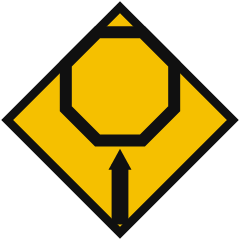
13. What is the driver expected to do after passing this sign?
Show answer
Answer A: Begin slowing so that a complete stop can be made at the intersection ahead
It is used where the control at the intersection stays hidden until late, so braking should begin here rather than at the stop line.
-
14. What base fine does California set for handheld phone violations?
Show answer
Answer D: $20 for a first offense and $50 for each later offense
Sections 23123 and 23123.5 set a base fine of $20 for a first offense and $50 for each subsequent offense, before penalty assessments are added.
-
15. How long must a California driver keep an ignition interlock device installed after a second conviction of driving under the influence?
Show answer
Answer D: 12 months
Section 23575.3 sets a mandatory 12-month interlock term for a second offense, rising to 24 months for a third and 36 months for a fourth.
-
16. When may a California driver take a vehicle across a fire hose lying in the roadway?
Show answer
Answer A: Only when protective jumpers or appliances are in place
Section 21708 forbids driving over or across a fire hose unless suitable jumpers or other appliances are installed to protect the hose.
-
17. In California, what is the speed limit within 500 feet of a school while children are outside or crossing the street?
Show answer
Answer D: 25 mph
California sets 25 mph within 500 feet of a school when children are present, and some school zones are posted as low as 15 mph.
-
18. In California, within what distance must you dim high-beam headlights for an oncoming vehicle and for a vehicle you are following?
Show answer
Answer D: 500 feet for oncoming vehicles and 300 feet for a vehicle you are following
California requires dimming to low beams within 500 feet of an oncoming vehicle and within 300 feet of a vehicle ahead of you.
-
19. Where does California's move over law apply?
Show answer
Answer D: On any highway in the state
Section 21809 applies to a person driving a vehicle on a highway, so the duty is not confined to freeways.
-
20. A yellow diamond on an exit ramp shows a truck tipping over onto two wheels. Which drivers does it concern most?
Show answer
Answer D: Those in tall vehicles carrying a high load
The truck rollover sign warns that the curve can overturn a vehicle with a high center of gravity, so such drivers must slow well below the normal ramp speed.
-
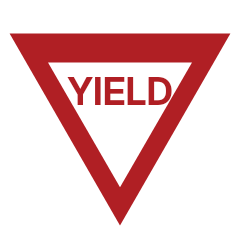
21. A driver reaches this sign and the intersecting roadway is completely clear. What is required?
Show answer
Answer D: Slowing to a speed that allows stopping, then going on without stopping if the way stays clear
This control asks the driver to slow down and be ready to stop, and a full stop becomes necessary only when traffic or pedestrians would otherwise be interfered with.
-
22. Just before the front wheel reaches an obstacle, what should you do with the throttle?
Show answer
Answer C: Roll it on slightly to lighten the front end
A small amount of throttle shifts weight rearward and lightens the front wheel so it rides over the obstacle more easily.
-
23. On a long uphill grade a second lane opens on the right and a sign directs slower traffic into it. You are towing a trailer and holding up a line of vehicles. What should you do?
Show answer
Answer A: Move into the right-hand lane and let the faster traffic use the left lane
A climbing lane exists so that slow vehicles can be passed safely, and the slower vehicle is the one that belongs in it.
-
24. What is the purpose of the padding built into the shoulders, elbows and knees of riding gear?
Show answer
Answer C: It absorbs impact energy at the joints most likely to strike first
Armor at the joints spreads and absorbs the force of an impact in the places that usually hit the ground first in a fall.
-
25. What is the difference between a California Class M1 and a Class M2 license?
Show answer
Answer A: M1 covers any two-wheel motorcycle and everything M2 covers, while M2 covers only motorized bicycles, mopeds and motorized scooters
California issues Class M1 for any two-wheel motorcycle, motor-driven cycle or motorized scooter plus all M2 vehicles, while Class M2 is limited to motorized bicycles, mopeds and motorized scooters.