
California DMV Motorcycle Practice Test 63
- Questions25
- Correct to pass20
- Passing score80%
- Minimum age15 years 6 months
-
1. Halfway through a curve you realize you are going too fast. What is the best response?
Show answer
Answer C: Ease off the gas gently and look where you want to go
Easing off transfers a little weight to the front tires without upsetting the balance, and looking through the curve keeps your steering smooth.
-
2. What should a passenger hold on to while the motorcycle is moving?
Show answer
Answer B: The operator's waist, hips or belt, or a handhold provided for the passenger
Holding the operator's waist, hips or belt, or a handhold designed for the passenger, keeps the passenger secure under acceleration and braking without pulling the operator off balance.
-
3. What is the first thing to do once your disabled vehicle is stopped on the shoulder?
Show answer
Answer A: Switch on the hazard warning lights so other drivers can see the vehicle
Hazard lights are the fastest way to make a stopped vehicle visible, and everything else can follow once traffic has been warned.
-
4. From which lane should a permitted U-turn be started?
Show answer
Answer A: The lane nearest the center line, the same one used for a left turn
A U-turn is begun from the far left lane for your direction, the same position used for a left turn, so you do not cut across traffic beside you.
-
5. Two solid white lines are painted between your lane and the lane beside it. What do they mean?
Show answer
Answer D: Crossing from one lane to the other is prohibited
Double solid white lines separate lanes of traffic going the same way and may not be crossed.
-
6. A raised area crosses the roadway and carries a series of white markings on its face. What are those markings for?
Show answer
Answer A: To make the hump visible so drivers slow for it
Speed hump markings warn drivers that the pavement rises, which matters most at night or when the hump is in shadow.
-
7. You are riding directly into a low sun that is glaring off your face shield. What should you do?
Show answer
Answer A: Slow down and assume that drivers ahead of you cannot see you either
Glare cuts what everyone can see, so lower speed buys reaction time, and a driver blinded by the same sun is even less likely to notice a motorcycle.
-
8. You must cross tracks or pavement seams that run in nearly the same direction as your path of travel. What should you do?
Show answer
Answer C: Move far enough away to cross at an angle of at least 45 degrees, then turn sharply across
A shallow crossing lets the groove catch and steer the front wheel, so the rider sets up to cross at 45 degrees or more and makes one deliberate turn across it.
-
9. You are riding where fresh pavement meets an older lane that sits an inch or two lower. How should you move across that edge?
Show answer
Answer A: Slow down and cross the edge at as sharp an angle as the lane allows
A pavement edge break can steer the front wheel along it if you meet it at a shallow angle, so slow, hold the bars firmly and cross it steeply.
-
10. Why should you avoid parking over tall dry grass or a pile of dead leaves?
Show answer
Answer B: Because the hot exhaust can set the dry material on fire
The exhaust system stays hot for a long time after a drive and can ignite dry vegetation underneath the vehicle.
-
11. You enter a work zone at night where one lane is closed and a flagger is on duty. What is the safest approach?
Show answer
Answer A: Slow early, merge before the closure and be ready to stop
Merging early at a reduced speed keeps the queue orderly and leaves you room to stop for equipment, workers or traffic that has halted ahead.
-
12. At an intersection the signal flashes red toward you and flashes yellow toward the cross street. Who must yield?
Show answer
Answer D: You must, because the flashing red faces your road
A flashing red means stop and yield like a stop sign, while a flashing yellow lets the other road proceed with caution.
-
13. Where should the rider be looking during a U-turn?
Show answer
Answer B: All the way around toward the point where the turn will finish
A motorcycle follows the eyes, so turning the head to the exit of the turn keeps the machine coming round instead of drifting wide.
-
14. Is a helmet worth wearing on a short trip to a store a few blocks away?
Show answer
Answer C: Yes, since many crashes happen close to home at ordinary street speeds
A large share of motorcycle crashes occur on short, familiar trips at moderate speeds, and injuries at those speeds are still severe.
-
15. When is passing another vehicle on the right generally permitted?
Show answer
Answer C: When the road has two or more lanes in your direction, or the vehicle ahead is turning left and there is room without leaving the pavement
Passing on the right is limited to situations where a lawful lane exists for it or the vehicle ahead is turning left, and it may never be done by driving onto the shoulder.
-
16. What kind of gloves are recommended for riding?
Show answer
Answer A: Full fingered gloves of leather or similar durable material
Full fingered leather or equivalent gloves improve grip on the controls and protect the hands, which riders instinctively put out in a fall.
-
17. You have just driven through a deep puddle and your brakes feel weak. What should you do?
Show answer
Answer D: Drive slowly while lightly applying the brakes until they dry and work normally
Wet brakes grip poorly and may pull to one side. Gentle braking at low speed generates heat that dries the pads and discs quickly.
-
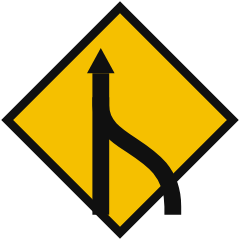
18. What is the safest way to deal with the situation this sign announces?
Show answer
Answer B: Match the speed of the other traffic stream and open a gap so vehicles can blend without hard braking
Blending works when speeds are matched and gaps are opened, so nobody has to brake hard or swerve where the two streams come together.
-
19. An emergency vehicle is stopped on the shoulder ahead with its lights flashing. What does the move over principle require?
Show answer
Answer D: Change lanes away from it, or slow down if you cannot
Move over laws ask you to give responders an empty lane, and where traffic or a two-lane road makes that impossible, you slow down instead.
-
20. What should a rider do if the front wheel locks during braking?
Show answer
Answer A: Release the front brake immediately, then reapply it firmly
A locked front wheel cannot steer or hold the motorcycle up, so the brake must be released to let the wheel roll again and then reapplied smoothly.
-
21. Which information in a California driver record is NOT available to the public?
Show answer
Answer D: Physical or mental conditions, address and social security number
Most information in the driver record is public, except physical or mental conditions, address and social security number.
-
22. To make a motorcycle lean into a turn at normal riding speed, the rider should:
Show answer
Answer C: Press forward on the handgrip on the side of the turn
This is countersteering: press left to lean left and go left, press right to lean right and go right.
-
23. What should a passenger be told about where to keep their legs?
Show answer
Answer D: To keep them away from the muffler, the chain and other moving parts
Exhaust pipes get hot enough to burn and exposed drive components can catch a loose leg, so the passenger must keep legs in and clear of them.
-
24. What does a blood alcohol concentration of 0.08 mean for the driver of a car?
Show answer
Answer B: It is the level almost every state treats as legally intoxicated
In almost every state a driver at 0.08 or above is legally intoxicated whatever the driver seems like, but impairment starts well before that level is reached.
-
25. A wide crosswalk you are turning across has a refuge island in the middle. What should you assume about people standing on it?
Show answer
Answer D: They may step off the island into your path at any moment
An island is a pause in a crossing, not the end of one, so treat anyone on it as a pedestrian who is still crossing.