
California DMV Motorcycle Practice Test 64
- Questions25
- Correct to pass20
- Passing score80%
- Minimum age15 years 6 months
-
1. What does California forbid within the block where a fire department vehicle has responded to an emergency?
Show answer
Answer D: Driving there at all unless an official directs you through
Section 21707 bars operating a vehicle within the block where a fire department vehicle is answering an emergency, unless fire, police, sheriff or CHP personnel direct otherwise, and applies within 300 feet when the nearest intersection is farther away.
-
2. How does a wet road change the distance you need to stop?
Show answer
Answer C: It lengthens it, so you need a much bigger gap ahead
Water between the tire and the road cuts grip, so braking distance grows and the gap that works on dry pavement is no longer enough.
-
3. You are ready to pull out of a parallel parking space into the traffic lane. What should you do?
Show answer
Answer C: Signal, check the mirror and blind spot, and wait for a gap
A driver leaving a parking space must yield to traffic already in the lane, so signal, look for the gap and only then move out.
-
4. What does a flashing yellow traffic light mean?
Show answer
Answer B: Slow down and proceed with caution
A flashing yellow lets you enter the intersection cautiously after yielding to pedestrians and to conflicting traffic that is already there.
-
5. Your road ends at a T-intersection with no signs or signals. Who has the right-of-way?
Show answer
Answer A: Traffic on the through road, and you must yield before entering
A driver on a road that ends at a T-intersection must yield to traffic on the through road that continues past the junction.
-
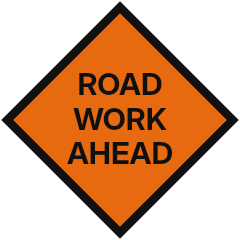
6. Beyond this sign, cones and temporary signs lead traffic along a path that does not agree with the lines painted on the pavement. Which one must the driver follow?
Show answer
Answer C: The temporary arrangement, because it replaces the permanent layout while the work lasts
Temporary traffic control set up for the work takes precedence over the permanent signs and markings, which no longer describe how the road is being used.
-
7. How should your following distance change in heavy rain?
Show answer
Answer D: It should be increased well beyond what you use on dry pavement
Wet pavement lengthens stopping distance and rain cuts visibility at the same time, so a larger gap gives you the extra seconds needed to see a problem and stop for it.
-
8. A bag strapped to the back of your motorcycle works loose and starts to shift as you ride. What should you do?
Show answer
Answer C: Slow smoothly, pull off the road, and secure the load before riding on
A load that moves changes the balance of the motorcycle and can foul a wheel or the chain, so stop as soon as you safely can and fasten it properly.
-
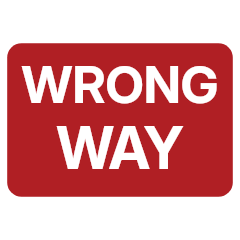
9. This sign comes into view ahead of a driver who has already started along a ramp. What should the driver do?
Show answer
Answer B: Pull clear where it is safe, then turn around and leave the ramp traveling properly
The driver is traveling against the legal flow, so the safest response is to stop clear of the lanes, turn the vehicle around and get off the ramp before meeting traffic head on.
-
10. Which California license class is required to drive a motor-driven cycle?
Show answer
Answer D: Class M1
DMV states that a motor-driven cycle must be registered and that you must have a motorcycle license, Class M1, to drive one.
-
11. Where is a strong crosswind most likely to hit you suddenly?
Show answer
Answer D: Coming out of a tunnel or a cut onto an open bridge
Gusts arrive the moment you leave shelter, which is why bridge approaches and the ends of cuts and tunnels catch drivers out.
-
12. Why do many crashes happen on routes the driver knows very well?
Show answer
Answer D: Familiar roads let attention slip into routine
When a route is automatic the mind wanders and hazards get missed, which is why a well known road deserves the same attention as a strange one.
-
13. Why is a motorcycle particularly hard for other drivers to judge at night?
Show answer
Answer A: Its single headlight gives no width cues for distance and speed
Drivers judge distance from the spacing between a pair of headlights, and a single lamp gives them nothing to measure, so they routinely misjudge how close and how fast a motorcycle is.
-
14. When should a rider add a layer on a ride that is turning cold?
Show answer
Answer D: Before you start to feel cold, at the next convenient stop
Once a rider is chilled it takes a long time to warm up again, and cold hands and slowed reactions cost control, so add layers before the cold takes hold.
-
15. Which of these makes you unpredictable to other drivers?
Show answer
Answer B: Changing lanes suddenly without signaling, to save a moment
An unsignalled, sudden lane change gives nobody time to react and is a common cause of sideswipe collisions.
-
16. On a long drive you notice repeated yawning, missed exits and drifting toward the lane line. What should you do?
Show answer
Answer C: Pull off at a safe place and sleep, or change drivers
Those are warning signs that sleepiness is already interfering with driving, and only rest restores alertness. Fresh air, music and caffeine do not reverse it.
-
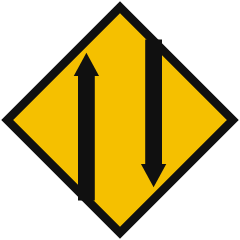
17. Which action becomes clearly more risky beyond this sign?
Show answer
Answer A: Using the left side of the roadway to overtake
With vehicles coming the other way on the same pavement, overtaking on the left needs enough clear road to pull out, pass and return, which is often not available.
-
18. What should a pre-ride check of the drive chain or belt look for?
Show answer
Answer C: Correct slack, adequate lubrication and no worn or damaged links
A chain that is too tight, too loose, dry or damaged can break or jump the sprocket and lock the rear wheel while the motorcycle is moving.
-
19. A bee gets inside your jacket while you are riding. What is the recommended action?
Show answer
Answer B: Pull off the road and stop before you try to deal with the insect
Being stung hurts, but losing control while swatting hurts much more, so ride to a safe place, stop and then deal with the insect.
-
20. You must stop for a train at a highway-rail crossing. Where should you stop?
Show answer
Answer B: Behind the stop line, gate or signal and well clear of the nearest rail
Stop behind the stop line, gate or flashing-light signal and well clear of the nearest rail, because a train overhangs its track by several feet on each side.
-
21. You notice at night that one of your headlights has burned out. What should you do?
Show answer
Answer B: Get it replaced promptly, because other drivers may take you for a motorcycle
A single light makes your vehicle look narrower and further away, so other drivers misjudge you, and one light is also illegal.
-
22. What is the role of the sweep rider in a group?
Show answer
Answer B: To ride last, watch the group, and notice when a rider drops back or has trouble
The sweep rider takes the last position so that any rider who slows, stops or has a problem is noticed instead of being left behind.
-
23. A pedestrian is crossing at a corner where no crosswalk is painted on the pavement. What is your duty?
Show answer
Answer A: Yield, because a legal crosswalk exists at the corner even without paint
Every intersection has a crosswalk whether or not it is marked, and drivers must yield to pedestrians crossing there.
-
24. You reach a red light with a sign reading NO TURN ON RED. What may you do?
Show answer
Answer D: Wait for the green; no turn is allowed while the light is red
That sign removes the usual permission to turn on red at the intersection, so you must wait for a green indication.
-
25. What penalty does California set for a first conviction of driving while the license is suspended or revoked?
Show answer
Answer D: Up to six months in county jail, a fine of $300 to $1,000, or both
Section 14601.1 punishes a first offense with up to six months in county jail, a fine of not less than $300 and not more than $1,000, or both.