
California DMV Permit Practice Test 1
Test 1 of 10. Pick an answer for each question to see if it is right and why; your score appears at the end. You need 30 correct answers to pass, the same ratio as the real California test.
- Questions36
- Correct to pass30
- Passing score83%
- Minimum age15 years 6 months
-
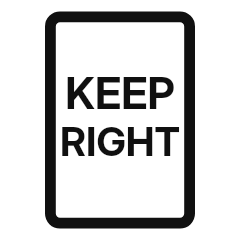
1. A driver ignores this sign and passes on the opposite side. What is the main risk?
Show answer
Answer B: Ending up on the wrong side of a divider, facing traffic coming the other way
The sign settles which side of a fixed divider is the legal one, so taking the other side sends the vehicle into the opposing stream or straight at the obstruction.
-
2. A rear tire blows out on the highway. How does the vehicle usually behave?
Show answer
Answer C: The back end weaves or fishtails from side to side
A rear failure shows up as the tail wandering rather than a pull on the steering, so hold the wheel straight and let the speed drop gradually.
-
3. The electric windows will not work as your vehicle sinks in water. What is the best option?
Show answer
Answer C: Break a side window with a hard, pointed object and climb out through it
Side windows are tempered glass and can be broken, while the laminated windshield cannot, and water pressure holds the doors shut.
-
4. What is the minimum age to apply for a California instruction permit if you are under 18?
Show answer
Answer C: 15 years and 6 months
California requires an applicant under 18 to be at least 15 years and 6 months old and to complete a driver education program before applying for an instruction permit.
-
5. A sign warns that your exit leaves from the left side of the freeway. What should you do?
Show answer
Answer D: Move into the left lane in good time before you reach the exit
Left-hand exits are unusual, which is exactly why they are signed well in advance and why the lane changes should be finished early.
-
6. A loaded truck is coming up an entrance ramp as you approach in the right lane of the freeway. What is the most helpful action?
Show answer
Answer A: Adjust your speed to open a gap for it
A heavy vehicle accelerates slowly, so opening a gap or moving over costs you seconds and saves the truck driver from being forced to stop on the ramp.
-
7. You and an oncoming driver are both turning left at the same intersection. What is the usual rule?
Show answer
Answer D: Both turn in front of each other unless markings show otherwise
The normal practice is to pass driver side to driver side, turning in front of one another, unless pavement markings or signs direct a different path.
-
8. Which of the four blind spots around a tractor-trailer is the largest?
Show answer
Answer A: The one on the right side of the truck
A truck has no-zones on all four sides, and the right-side blind spot is the largest because it runs back along the trailer and reaches across more than one lane.
-
9. Your loaded vehicle weighs more than the figure shown on a posted weight limit sign. What must you do?
Show answer
Answer D: Find another route, because crossing is not permitted
A posted weight limit is a legal maximum, not advice, so an overweight vehicle has to take a different route.
-
10. A pedestrian steps off the curb in the middle of a block where there is no crosswalk at all. What is the legal position?
Show answer
Answer A: They must yield to you, but you must still avoid a crash
A pedestrian crossing away from a crosswalk yields to vehicles, yet every driver still has a duty to use care and avoid hitting a person.
-
11. How may an adult California driver legally use a cell phone that is mounted on the windshield or dashboard?
Show answer
Answer D: With a single swipe or touch, in hands-free mode
California permits adult drivers to use a mounted phone in hands-free mode with a single swipe or touch, and prohibits holding the device while driving.
-
12. What does California's basic speed law require?
Show answer
Answer A: Never drive faster than is reasonable or prudent for the conditions
Section 22350 forbids driving at a speed greater than is reasonable or prudent given weather, visibility, traffic and the surface and width of the highway, and never at a speed that endangers persons or property.
-
13. In California, what happens to the driving privilege of a person aged 13 to 20 who is convicted of an alcohol or drug offense?
Show answer
Answer D: The court suspends or delays the driving privilege for one year
Section 13202.5 requires the court to suspend the driving privilege for one year, or to delay eligibility for one year if the person is not yet licensed, after a drug or alcohol conviction between the ages of 13 and 20.
-
14. Yellow signs each showing one large black arrowhead, installed in a row along the outside of a curve, are
Show answer
Answer D: chevron alignment signs marking the change of direction of the curve
Chevron alignment signs are placed on the outside of a curve so that several are in view at once, letting the driver judge how sharply the road turns.
-
15. How soon must a California driver report a collision that injured or killed someone to the CHP or the local police?
Show answer
Answer B: Within 24 hours of the collision
Section 20008 requires a written report to the California Highway Patrol, or to the city police department where the crash happened, within 24 hours of a collision causing injury or death.
-
16. A vehicle coming toward you has drifted into your lane. What should you do?
Show answer
Answer D: Slow down, sound the horn, flash your lights and steer to the right if possible
Moving right gives the other driver space to recover and keeps you out of the lane they are most likely to return to. Braking reduces the force of any impact.
-
17. Besides emergency vehicles, tow trucks and highway maintenance vehicles, which stopped vehicle triggers California's move over duty?
Show answer
Answer A: Any vehicle displaying hazard lights, cones or flares
Section 21809 extends the duty to any other stationary vehicle displaying flashing hazard lights or another warning device, including cones, flares or retroreflective devices.
-
18. What does California require a licensed driver to do with the driver license while driving on a highway?
Show answer
Answer B: Have it in immediate possession and present it on the demand of a peace officer
Section 12951 requires the licensee to have the valid license in immediate possession at all times when driving, and to present it when a peace officer enforcing the code demands it.
-
19. You are stopped inside an intersection waiting for a gap to turn left. How should your front wheels be positioned?
Show answer
Answer C: Pointing straight ahead until you actually begin the turn
If your wheels are already turned left and another vehicle strikes you from behind, you would be pushed into oncoming traffic.
-
20. The cars in front of and behind your parallel parked car have left you very little room. How do you get out?
Show answer
Answer D: Ease back and forth, turning the wheels each way, until you clear
Short movements with the wheels turned first one way and then the other walk the car out of a tight space without touching anything.
-
21. You arrive at an intersection where the traffic signal is completely dark because of a power failure. How should you proceed?
Show answer
Answer C: Treat the intersection as an all-way stop
When a signal shows no indication at all, drivers on every approach must stop and then take turns, exactly as at an all-way stop.
-
22. Small green signs with white numerals posted at regular intervals along a highway are used to
Show answer
Answer B: show distance along the route and give a reference point for reporting a location
Reference location signs, commonly called mileposts, carry white numerals on green and let a driver describe exactly where a breakdown or crash has occurred.
-
23. Your brake pedal sinks to the floor and the vehicle does not slow down. What is a reasonable sequence of actions?
Show answer
Answer C: Pump the pedal, shift to a lower gear and apply the parking brake gradually while steering to a safe spot
Pumping can rebuild pressure in a partly failed system, a lower gear adds engine braking, and easing on the parking brake slows the vehicle without locking the wheels.
-
24. How should you position your vehicle for a right turn from a two-way street?
Show answer
Answer B: As close as practical to the right curb or edge, then turn into the nearest right lane
Right turns are made from the lane nearest the right edge into the nearest available lane, which keeps the turn tight and prevents a wide sweep into other traffic.
-
25. Two vehicles meet on a steep, narrow mountain road with no room to pass. Which driver should back up?
Show answer
Answer C: The driver heading downhill, who has more control while reversing
On a narrow mountain road the vehicle facing downhill yields, because backing uphill gives better control than reversing down a grade.
-
26. Which surfaces usually offer less grip than the pavement around them when wet?
Show answer
Answer B: Painted markings, metal plates and bridge decks
Paint, steel and bridge decks all shed grip when wet or cold, so brake before you reach them rather than on top of them.
-
27. What penalty does California set for a first conviction of driving while the license is suspended or revoked?
Show answer
Answer D: Up to six months in county jail, a fine of $300 to $1,000, or both
Section 14601.1 punishes a first offense with up to six months in county jail, a fine of not less than $300 and not more than $1,000, or both.
-
28. You have stopped on an uphill grade close behind a large truck at a traffic signal. What is the risk?
Show answer
Answer B: The truck may roll back into you when it starts to move
Heavy vehicles can roll backward a short distance when the driver moves from the brake to the accelerator on a hill. Leave extra room when stopped behind a truck on a grade.
-
29. What offense does California create for a driver under 21 who drives with 0.05 percent alcohol in the blood?
Show answer
Answer A: A separate offense that stands on its own, apart from the adult limit
Section 23140 makes it unlawful for a person under 21 to drive with 0.05 percent or more alcohol in the blood, an offense distinct from the adult standard and from the zero tolerance rule.
-
30. Low sun is shining onto the signal ahead and you cannot tell which light is lit. What should you do?
Show answer
Answer D: Slow down and be ready to stop until you can be sure
An unreadable signal has to be treated as one that may be red, so approach slowly enough to stop while you work out what it shows.
-
31. A bicyclist is riding in the middle of a narrow travel lane ahead of you. What is the correct response?
Show answer
Answer D: Slow down and wait until you can pass with wide clearance, changing lanes if needed
A bicyclist has the same right to use the lane as a driver, and a narrow lane may not leave safe passing room, so wait for a gap that lets you move over and pass with a wide margin.
-
32. A city transit bus ahead of you has stopped at the curb with its passenger door open. What does the law require of you?
Show answer
Answer D: Nothing special, but pass slowly and watch for people
The mandatory stop applies to a school bus showing red flashing lights, not to a transit bus, though a careful driver still slows for crossing passengers.
-
33. What base fine does California set for handheld phone violations?
Show answer
Answer D: $20 for a first offense and $50 for each later offense
Sections 23123 and 23123.5 set a base fine of $20 for a first offense and $50 for each subsequent offense, before penalty assessments are added.
-
34. A yellow diamond shows an arrow bent into a series of reversing turns. What does it warn about?
Show answer
Answer A: Three or more changes of direction close together
The winding road sign replaces a string of separate curve signs where several bends follow one another with only short straights between them.
-
35. How many points does California add to a driving record for a conviction of driving under the influence?
Show answer
Answer C: Two points
Section 12810 assigns two points to a conviction under section 23152 or 23153, the same count it gives reckless driving and failing to stop after a collision.
-
36. You are starting from a stop on a snowy, icy street and the drive wheels begin to spin. What should you do?
Show answer
Answer C: Ease off the accelerator and start again more gently
Spinning tires polish the surface and dig in. Very gentle pressure on the accelerator, and a higher gear if you have one, gives the tires the best chance to grip.