
California DMV Permit Practice Test 4
Test 4 of 10. Pick an answer for each question to see if it is right and why; your score appears at the end. You need 30 correct answers to pass, the same ratio as the real California test.
- Questions36
- Correct to pass30
- Passing score83%
- Minimum age15 years 6 months
-
1. You are turning left from a one-way street onto another one-way street. Which lane should you use?
Show answer
Answer B: Turn from the far left lane into the far left lane of the new street
The general turning rule is to turn from the lane nearest the direction of the turn into the nearest lane of the new roadway, which on a one-way to one-way left turn means far left to far left.
-
2. Why should you make sure your turn signal has stopped flashing after a lane change?
Show answer
Answer A: A signal left flashing tells other drivers that you intend to move again
Other drivers act on your signals, so one that is left on gives them false information about what you are about to do.
-
3. How does alcohol change the time a driver needs to respond to a hazard?
Show answer
Answer A: It slows it, so stopping takes longer
Alcohol is a depressant that lengthens the time between seeing a hazard and acting on it, which adds directly to the distance needed to stop.
-
4. A yield sign is posted where an entrance ramp meets the highway. What must you do?
Show answer
Answer C: Give way to the traffic already on the highway and merge into a gap
The yield sign confirms that the merging driver is the one who must fit into the traffic stream rather than the other way round.
-
5. You have just merged onto a freeway from an entrance ramp. What should you do next?
Show answer
Answer C: Settle into the right lane and build up speed before changing lanes
Crossing lanes while you are still below the speed of the traffic forces other drivers to brake, so the speed comes first and the lane change second.
-
6. An overhead lane-use control signal shows a steady red X above your lane. What does it mean?
Show answer
Answer B: You may not use that lane and must move out of it
A steady red X means the lane below it is closed to you, while a steady yellow X is the warning to prepare to vacate the lane and a downward green arrow means the lane is open.
-
7. You come back to find that your parked car has rolled out into the street. What most likely went wrong?
Show answer
Answer C: The parking brake was not set and the wheels were not turned
The parking brake, a gear or park, and turned front wheels are three separate safeguards, and a runaway means at least the first two were missing.
-
8. What is threshold braking?
Show answer
Answer C: Braking hard but staying just short of locking the wheels
A rolling tire grips better than a sliding one, so the shortest stop comes from pressure held just below the point where the wheels lock.
-
9. The added lane warning sign tells a driver that
Show answer
Answer A: an extra lane begins ahead, so entering traffic does not have to merge into an existing lane
Where a lane is added, traffic entering the roadway gets a lane of its own, so merging is not required, although drivers should still watch the vehicles beside them.
-
10. From what distance may a California vehicle sound system not be audible while the vehicle is driven on a highway?
Show answer
Answer C: 50 feet or more
Section 27007 forbids operating a sound amplification system that can be heard from 50 feet or more outside the vehicle while it is driven on a highway.
-
11. You are passing a large truck on an open highway in a strong crosswind. What should you expect?
Show answer
Answer A: A push toward the truck, then a push the other way as you clear it
The truck shelters you as you go by and then releases you into the full gust, so the load on the steering changes twice during the pass.
-
12. What does California law allow a driver under 18 to do with a cell phone while driving?
Show answer
Answer A: Only make an emergency call
California bars minors from using a cell phone or electronic wireless device to answer calls or send messages, allowing only calls for emergency purposes.
-
13. Your phone is in a mount on the dashboard rather than in your hand. What is true?
Show answer
Answer B: It still takes your eyes and mind off the road
A mount solves the hand problem but not the eye or the mind problem, and reading or tapping a mounted screen costs the same seconds of attention.
-
14. Why should you avoid parking over tall dry grass or a pile of dead leaves?
Show answer
Answer B: Because the hot exhaust can set the dry material on fire
The exhaust system stays hot for a long time after a drive and can ignite dry vegetation underneath the vehicle.
-
15. About how much alcohol can the body eliminate per hour?
Show answer
Answer A: About one standard drink
The liver removes alcohol at a nearly fixed rate of roughly one standard drink per hour. Drinking faster than that raises the blood alcohol level, and nothing speeds the process.
-
16. At a freeway exit, the paved triangle between the ramp and the through lanes is filled with diagonal white lines. What do they mean?
Show answer
Answer A: Stay out of that area, because it is not meant to be driven on
Chevron and diagonal markings fill paved areas that traffic is not intended to use, so drivers should keep out of them.
-
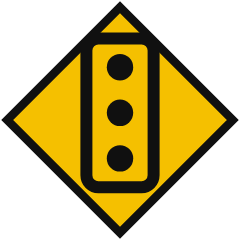
17. Why would this sign be installed on an approach?
Show answer
Answer B: Because the signal cannot be seen from far enough back for a driver to react in time
Advance notice of a signal is used where a crest, a curve, trees or a building keep the signal heads out of view until a driver is already too close to stop comfortably.
-
18. What is the safest way to handle an unrestrained pet or a child who needs attention while you are driving?
Show answer
Answer D: Secure pets before the trip and pull over safely before attending to a child
A loose animal or an urgent situation in the back seat can capture a driver's attention completely, so restrain pets beforehand and stop in a safe place when someone needs help.
-
19. What fine does California set for a first safety belt violation by an adult?
Show answer
Answer A: Not more than $20
Section 27315 makes an adult safety belt violation an infraction punishable by a fine of not more than $20 for a first offense and not more than $50 for each later offense.
-
20. What must a California applicant bring to the behind-the-wheel drive test besides the instruction permit?
Show answer
Answer C: A safe vehicle with proof of insurance and registration, plus a licensed driver
The California Driver's Handbook requires the applicant to arrive with a roadworthy vehicle, valid proof of insurance and registration, and a licensed driver who can take the vehicle away.
-
21. A sign warns that the right lane ends ahead, and traffic is still flowing freely. What should you do if you are in that lane?
Show answer
Answer C: Signal, adjust your speed and move left in good time before the lane ends
When traffic is moving freely there is room to merge early and smoothly, which avoids the last-second lane change at the closure point.
-
22. What two choices does California's move over law give a driver approaching a stationary vehicle that is displaying warning lights?
Show answer
Answer B: Change into a lane not next to the vehicle, or slow to a prudent speed
Section 21809 requires the driver to make a lane change into an available lane not immediately adjacent to the stationary vehicle or, when that is unsafe or impracticable, to slow to a reasonable and prudent speed.
-
23. A disabled vehicle is blocking your lane on a two-lane road with a single solid yellow line on your side. What should you do?
Show answer
Answer C: Wait until the oncoming lane is clear, then go around carefully
The solid line prohibits overtaking a moving vehicle, but in most states a driver may go around an obstruction such as a disabled vehicle once the oncoming lane is clear and the move can be made safely.
-
24. An oncoming driver flashes their headlights while you are waiting to turn left. What should you do?
Show answer
Answer D: Judge the situation yourself, since the flash may mean something else
A flash is not a legal signal and may mean many things, so the decision to turn stays yours and must be based on what you can see.
-
25. A yellow diamond in which one line joins another at an angle warns that
Show answer
Answer B: traffic from another roadway will merge into the driver's lane ahead
The merge sign warns that another traffic stream will join the same lane ahead, so drivers on both roadways must adjust speed and spacing.
-
26. What does California impose on a first conviction for engaging in a motor vehicle speed contest on a highway?
Show answer
Answer B: Jail of 24 hours to 90 days, a fine of $355 to $1,000 and community service
Section 23109 sets 24 hours to 90 days in jail, a fine of $355 to $1,000 and 40 hours of community service for a first speed contest conviction.
-
27. A highway lane is marked with a large white diamond and signed as a high-occupancy vehicle lane. Who may use it?
Show answer
Answer B: Only vehicles carrying at least the number of occupants shown on the sign, during the posted hours
The diamond marking identifies a preferential lane whose occupancy requirement and hours of operation are stated on the accompanying signs.
-
28. In a California residential district, when may you make a U-turn where no sign prohibits it?
Show answer
Answer B: When no vehicles are approaching within 200 feet
California allows a U-turn in a residential district when no vehicle is approaching you within 200 feet, and requires clear visibility of 200 feet in each direction.
-
29. What does California's Anti-Gridlock Act forbid a driver from doing?
Show answer
Answer A: Entering an intersection or crosswalk without room to clear it
Section 22526 bars a driver from entering an intersection or marked crosswalk unless there is enough space on the other side to accommodate the vehicle without obstructing traffic from either side.
-
30. When does a California handheld phone conviction add a point to the driving record?
Show answer
Answer C: Only within 36 months of a prior conviction for the same offense
Section 12810.3 gives a violation point for a handheld phone offense only when the violation occurs within 36 months of a prior conviction for the same offense.
-
31. You reach an intersection showing a steady red light, and a stop line is painted across your lane. Where must you bring the vehicle to a complete stop?
Show answer
Answer C: Before the stop line
A steady red requires a complete stop before the marked stop line. Where there is no stop line you stop before the crosswalk, and where there is neither, before entering the intersection.
-
32. In California, what blood alcohol concentration makes it illegal to drive for a person over 21?
Show answer
Answer D: 0.08 percent or higher
California prohibits driving with a blood alcohol concentration of 0.08 percent or higher for drivers over 21 years old.
-
33. You are following a large truck on a two-lane road and cannot see past it. What should you do before deciding to pass?
Show answer
Answer D: Drop back so that your view of the road ahead opens up
Distance is what buys you a view around a large vehicle, and no decision to pass can be made from a position where you cannot see.
-
34. In California, within what distance must you dim high-beam headlights for an oncoming vehicle and for a vehicle you are following?
Show answer
Answer D: 500 feet for oncoming vehicles and 300 feet for a vehicle you are following
California requires dimming to low beams within 500 feet of an oncoming vehicle and within 300 feet of a vehicle ahead of you.
-
35. You are inside a tunnel with no shoulder when an ambulance comes up behind you with lights and siren. What should you do?
Show answer
Answer D: Keep going at a safe speed and pull over once you are clear of the tunnel
Stopping in a tunnel or on a narrow bridge blocks the only lane, so continue at a safe speed to the first place where you can pull clear.
-
36. An emergency vehicle is stopped on the shoulder ahead with its lights flashing. What does the move over principle require?
Show answer
Answer D: Change lanes away from it, or slow down if you cannot
Move over laws ask you to give responders an empty lane, and where traffic or a two-lane road makes that impossible, you slow down instead.