
California DMV Permit Practice Test 2
Test 2 of 10. Pick an answer for each question to see if it is right and why; your score appears at the end. You need 30 correct answers to pass, the same ratio as the real California test.
- Questions36
- Correct to pass30
- Passing score83%
- Minimum age15 years 6 months
-
1. Fresh snow covers the road and earlier vehicles have left clear tracks. What line is usually best?
Show answer
Answer B: The existing tracks, where more of the tire can reach the surface
Running in the cleared tracks puts more rubber on the road surface than ploughing through loose snow, provided the tracks have not turned to polished ice.
-
2. In California, when may a child stop using a child passenger restraint system and use a safety belt instead?
Show answer
Answer C: At 8 years old or once the child is at least 4 feet 9 inches tall
California allows a properly secured safety belt once the child is 8 years old or measures at least 4 feet 9 inches, whichever comes first.
-
3. You are at a red light where right turns on red are allowed, you cannot see clearly, and the driver behind sounds the horn. What should you do?
Show answer
Answer C: Stay stopped until you can see that the turn is safe
Turning right on red is permitted, never required, so you wait until you can see that the way is clear no matter what the driver behind does.
-
4. Within how many days must a California driver file a Report of Traffic Accident Occurring in California with the DMV?
Show answer
Answer B: 10 days
California requires the SR 1 report to the DMV within 10 days when a collision causes more than $1,000 in property damage or any injury or death.
-
5. Unless otherwise posted, what is the maximum speed limit on most California highways?
Show answer
Answer A: 65 mph
The maximum speed limit on most California highways is 65 mph, dropping to 55 mph on two-lane undivided highways and for vehicles towing trailers.
-
6. A sign showing a figure with an outstretched thumb inside a red circle with a slash means that
Show answer
Answer B: soliciting a ride is prohibited there
The no hitchhiking sign bars standing beside the road to solicit a ride, and it is common along freeway ramps and shoulders.
-
7. How does heavy cargo on a roof rack change the way a vehicle handles?
Show answer
Answer D: It raises the center of gravity, so the vehicle tips more in turns and needs gentler steering
Weight carried high makes the vehicle lean more and roll over more easily, and extra weight lengthens stopping distance. Drive slower and steer smoothly with a loaded roof.
-
8. What blood alcohol concentration is unlawful in California for a driver carrying a passenger for hire?
Show answer
Answer C: 0.04 percent or more
Section 23152 makes it unlawful to drive with 0.04 percent or more alcohol in the blood when a passenger for hire is in the vehicle.
-
9. What minimum liability limits will California require beginning January 1, 2035?
Show answer
Answer A: $50,000 for one person, $100,000 for two or more, $25,000 for property
Section 16056 adds $20,000, $40,000 and $10,000 to the current figures from January 1, 2035, producing minimums of $50,000, $100,000 and $25,000.
-
10. What are the minimum liability coverage amounts required in California?
Show answer
Answer A: $30,000 for one death or injury, $60,000 for more than one person, and $15,000 for property damage
California requires liability coverage of at least $30,000 for a single death or injury, $60,000 when more than one person is involved, and $15,000 for property damage.
-
11. The trapezoid sign shape is associated with
Show answer
Answer C: recreational and cultural interest area signing
The trapezoid is used for recreational and cultural interest area guide signs and for national forest route markers.
-
12. Is it a good idea to shift into neutral and coast down a long hill to save fuel?
Show answer
Answer B: No, you lose engine braking and some control of the vehicle
In neutral the engine cannot help slow the vehicle, so the brakes do all the work and can overheat. Stay in gear so the drivetrain helps hold your speed.
-
13. Many signs use a symbol instead of words. The main advantage is that a symbol
Show answer
Answer C: can be read from farther away and by more people
A symbol is recognized at greater distance than a line of text and does not depend on the reader knowing English.
-
14. How does a wet road change the distance you need to stop?
Show answer
Answer C: It lengthens it, so you need a much bigger gap ahead
Water between the tire and the road cuts grip, so braking distance grows and the gap that works on dry pavement is no longer enough.
-
15. Unless the road is posted otherwise, what is the maximum speed on a California two-lane undivided highway?
Show answer
Answer B: 55 mph
Section 22349 caps a two-lane undivided highway at 55 miles per hour unless an engineering and traffic survey supports a higher posted limit.
-
16. Which color scheme is standard for the drums and barricades that channel traffic through a work zone?
Show answer
Answer C: Alternating orange and white retroreflective stripes
Drums and barricades carry alternating orange and white retroreflective stripes, and the traffic cones used in the same zones are predominantly orange.
-
17. You are following another vehicle down a long, steep grade. What should you do about the gap?
Show answer
Answer D: Make it longer, because both of you need more room to stop
Everything takes longer to stop on a downgrade, including the vehicle ahead, so the gap that works on the flat is no longer enough.
-
18. You are stopped in a shared through and right-turn lane with your right signal on, and a bicyclist rides up along your right side. What should you do?
Show answer
Answer A: Let the bicyclist clear the intersection or move ahead before you turn
A cyclist alongside your right side is in the path your turn will sweep across, so wait until that space is clear before turning.
-
19. On a narrow residential street, why does parking tight against the curb matter so much?
Show answer
Answer C: Because fire trucks and ambulances need the width to get through
Cars parked even a foot out from the curb on both sides can narrow a street until a fire truck or ambulance cannot pass.
-
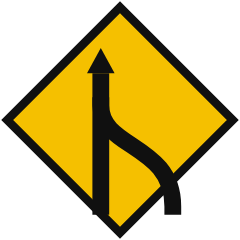
20. What is the safest way to deal with the situation this sign announces?
Show answer
Answer B: Match the speed of the other traffic stream and open a gap so vehicles can blend without hard braking
Blending works when speeds are matched and gaps are opened, so nobody has to brake hard or swerve where the two streams come together.
-
21. What is the maximum fine for a first California conviction of driving faster than 100 miles per hour?
Show answer
Answer C: $500
Section 22348 caps the fine for a first conviction of exceeding 100 miles per hour at $500, and the court may also suspend the driving privilege for up to 30 days.
-
22. A pedestrian waiting at a curb faces a steady upraised hand. What does that indication mean?
Show answer
Answer A: Do not start to cross in that direction
A steady upraised hand forbids entering the crosswalk, while a flashing hand only forbids starting a new crossing.
-
23. You are parking on a hill where there is no curb, whether facing up or down. Which way should the front wheels point?
Show answer
Answer B: Toward the shoulder, so the vehicle would roll away from the traffic lanes
With no curb to stop the vehicle, the wheels are turned toward the edge of the road so that a runaway vehicle leaves the roadway instead of entering it.
-
24. You realize you have driven several miles without remembering any of it. What kind of distraction is this?
Show answer
Answer C: Cognitive distraction, because your mind was not on driving
Daydreaming or being lost in thought is a cognitive distraction. Your eyes may be on the road, but your brain is not processing what they see.
-
25. Lights set into the pavement along both edges of a crosswalk start to flash yellow as you approach. What do they tell you?
Show answer
Answer D: Someone is crossing and has to be given way
In-roadway warning lights flash only when a pedestrian activates the crossing, so a flashing pattern means somebody is in or entering the crosswalk.
-
26. About how far ahead do low beam headlights let you see on a dark road?
Show answer
Answer B: About 250 feet
Low beams light roughly 250 feet of road, and high beams roughly 350 to 500 feet, which sets the limit on a safe night speed.
-
27. Reaching for a drink in the cup holder is which kind of distraction?
Show answer
Answer A: Manual and visual at the same time
Your hand leaves the wheel and your eyes flick down to find the cup, so a task that feels trivial takes away two of the three things driving needs.
-
28. Your headlights suddenly go out while you are driving at night. What should you do?
Show answer
Answer A: Try the dimmer switch and the headlight switch, turn on the hazard lights and pull off the road
Switching between high and low beams or cycling the light switch sometimes restores the lights. If not, use the hazard and parking lights to get off the road safely.
-
29. Roughly how far does a vehicle travel at 55 mph during the few seconds a driver spends reading a text message?
Show answer
Answer D: About the length of a football field
Sending or reading a message takes the eyes off the road for about five seconds, which at 55 mph covers roughly the length of a football field with nobody watching the road.
-
30. How closely may a California driver follow an authorized emergency vehicle that is answering a call?
Show answer
Answer C: No closer than 300 feet
Section 21706 forbids following within 300 feet of an authorized emergency vehicle that is operating under section 21055.
-
31. How long must a California applicant under 18 hold an instruction permit before scheduling the behind-the-wheel drive test?
Show answer
Answer A: At least 6 months
California requires a minor to hold a California or out-of-state instruction permit for at least six months, or to turn 18, before scheduling the behind-the-wheel drive test.
-
32. While you are still on an entrance ramp, where should your attention be?
Show answer
Answer D: Along the ramp ahead and back at the highway traffic in the mirrors and over your shoulder
A merge needs both halves of the picture at once: the ramp curving ahead of you and the traffic you are about to join behind and to your left.
-
33. You are traveling at 55 mph on a rural road and come up behind a horse-drawn buggy. What is the main danger?
Show answer
Answer D: You close on it very quickly because it moves at walking pace
A buggy travels only a few miles an hour, so the gap closes far faster than drivers expect and there is very little time to brake once you see it.
-
34. How many vehicles must be lined up behind a slow driver on a California two-lane highway before that driver must use a turnout?
Show answer
Answer B: Five or more
Section 21656 requires a slow-moving vehicle to turn off at the nearest designated turnout when the vehicles lined up behind it reach the statutory count and passing is unsafe.
-
35. Your car has side curtain airbags. What should you avoid doing?
Show answer
Answer B: Resting your head against the window or the door pillar
A side airbag deploys from the pillar or roof rail, so a head leaning against that area is directly in its path.
-
36. The car ahead of you slows down for no reason that you can see. Should you pull out and pass?
Show answer
Answer B: No, find out why it is slowing before you commit to the other lane
A driver usually slows for something, such as a turn, a hazard or a pedestrian, and that something is often exactly where your pass would take you.