
California DMV Permit Practice Test 3
Test 3 of 10. Pick an answer for each question to see if it is right and why; your score appears at the end. You need 30 correct answers to pass, the same ratio as the real California test.
- Questions36
- Correct to pass30
- Passing score83%
- Minimum age15 years 6 months
-
1. When may a California driver take a vehicle across a fire hose lying in the roadway?
Show answer
Answer A: Only when protective jumpers or appliances are in place
Section 21708 forbids driving over or across a fire hose unless suitable jumpers or other appliances are installed to protect the hose.
-
2. What maximum speed does the California Driver's Handbook give for rain or snow heavy enough that you cannot see 100 feet ahead?
Show answer
Answer C: 30 mph
The California Driver's Handbook instructs drivers to travel no faster than 30 miles per hour when rain or snow cuts visibility below 100 feet.
-
3. Where does California require a child under eight years old to ride?
Show answer
Answer C: In a rear seat, in a child passenger restraint system
Section 27360 requires a child under eight to be properly secured in an appropriate child passenger restraint system in a rear seat of the vehicle.
-
4. A fire truck with lights and siren has just passed you and is heading down the same road. How closely may you follow it?
Show answer
Answer B: Well back, because following a responding emergency vehicle closely is illegal
Following a responding emergency vehicle closely is prohibited; the exact minimum distance is set by each state, so stay far enough back to keep the scene and other responders clear.
-
5. What does California law say about wearing earphones while driving or riding a bicycle?
Show answer
Answer D: They may not cover or be inserted in both ears at the same time
Section 27400 forbids a person operating a motor vehicle or bicycle from wearing a headset covering, or earplugs or earphones in, both ears, with exceptions for emergency and maintenance workers and for hearing aids.
-
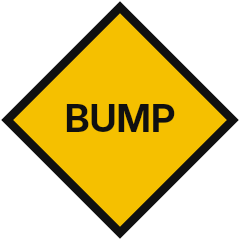
6. Why does this warning matter more on a motorcycle than in a car?
Show answer
Answer B: Because a sudden jolt can unsettle a two-wheeled machine and the rider can lose control
A jolt can push a motorcycle off line or lift a wheel, so a rider slows early, comes slightly off the seat and keeps a relaxed but firm hold on the handlebars.
-
7. During the first 12 months with a California provisional license, when may the driver not drive?
Show answer
Answer C: Between 11 p.m. and 5 a.m.
A California provisional driver may not drive between 11 p.m. and 5 a.m. during the first 12 months, unless one of the listed medical, school, work or family exceptions applies.
-
8. Why does a dirty windshield matter much more at night than during the day?
Show answer
Answer C: Dust and streaks scatter oncoming light and increase glare
Film and streaks on the glass spread every oncoming headlight into a star of glare, so clean the inside as well as the outside before a night trip.
-
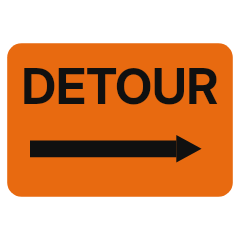
9. Which of these is true of the roadway a driver is being sent onto here?
Show answer
Answer D: Its own signs, signals and speed limits govern for the whole way around
The alternate route is an ordinary public road, so every control posted on it governs as usual; being sent that way grants no extra priority and no relief from the limits in force there.
-
10. You reach the end of the acceleration lane and there is still no gap in the traffic. What should you do?
Show answer
Answer B: Slow down and merge behind the traffic rather than forcing your way in
Merging behind the traffic costs you only a little speed, while forcing into a space that is not there puts you alongside a vehicle with nowhere to go.
-
11. When does the California DMV suspend the driving privilege of a driver who cannot show financial responsibility after a reportable collision?
Show answer
Answer D: Thirty days after the department mails its notice
Section 16070 directs the department to suspend the driving privilege 30 days after mailing the notice unless the driver establishes the required financial responsibility first.
-
12. Well before an intersection, an overhead sign shows a diagram of the lanes with an arrow above each one. What is its purpose?
Show answer
Answer C: To let drivers pick the correct lane in good time
Advance intersection lane control signs display the lane assignment far enough back that drivers can move over calmly instead of at the last moment.
-
13. An orange sign reading END ROAD WORK is posted beside the highway. What does it mark?
Show answer
Answer C: The point where the work zone restrictions stop
The sign is installed at the downstream end of the temporary traffic control zone to tell drivers that normal conditions apply again.
-
14. Two solid yellow lines are painted down the center of a two-way road. What do they mean?
Show answer
Answer B: Traffic in neither direction may cross them to pass
A double solid yellow line marks a no-passing zone that applies to traffic traveling in either direction.
-
15. What does California require of drivers aged 70 and older when the license expires?
Show answer
Answer A: They must renew in person and pass a vision test
The California Driver's Handbook states that drivers 70 and older must renew in person and pass a vision test, and that other exams may be required in some cases.
-
16. What does California impose for a second refusal of a chemical test within 10 years of a prior DUI incident?
Show answer
Answer D: A two-year revocation of the driving privilege
Section 23612 turns a second refusal within 10 years into a two-year revocation, and a third or later refusal into a three-year revocation.
-
17. Which effect appears as a drinker's blood alcohol level climbs well past the first drinks?
Show answer
Answer D: Loss of muscle control and steady steering
Higher levels of alcohol reach the parts of the brain that control movement, which shows up as clumsy steering, late braking and poor lane control.
-
18. How long does a California driver have to notify the DMV after moving to a new address?
Show answer
Answer C: 10 days
Section 14600 requires a licensee to notify the department of both the old and the new address within 10 days of acquiring the new residence or mailing address.
-
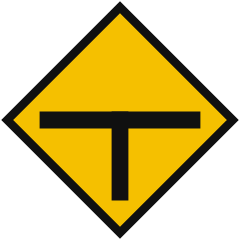
19. On which approach is this sign normally installed?
Show answer
Answer C: On the road that ends, far enough ahead for the driver to slow down
The warning belongs on the approach that terminates, placed early enough that the driver can lose speed and choose a direction before reaching the junction.
-
20. Where is a U-turn generally the most reasonable choice?
Show answer
Answer B: At an intersection where it is permitted and you can see well both ways
A U-turn needs a legal place and a long clear view in both directions, which is why a permitted intersection with open sight lines is the usual choice.
-
21. How do worn tires and worn brakes affect your ability to stop?
Show answer
Answer C: They lengthen the stopping distance, especially on a wet road
Worn tread cannot clear water and worn brakes cannot produce full force, so both stretch the distance needed to stop.
-
22. You are in the middle of an intersection when you hear a siren and see an emergency vehicle approaching. What should you do?
Show answer
Answer A: Keep going, clear the intersection, then pull to the right and stop
Stopping inside an intersection blocks the emergency vehicle. Clear the intersection first, then pull over to the right and stop.
-
23. A driver on the street this sign governs is preparing to turn left at the next corner. Which lane should the vehicle be in beforehand?
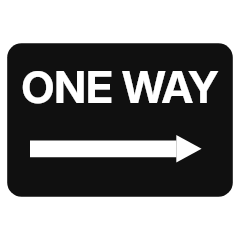
Show answer
Answer A: The lane closest to the left curb
All the traffic here runs the same way, so nothing is coming toward the driver and the turn is taken from the extreme left lane rather than from beside the middle of the roadway.
-
24. An oncoming vehicle at night has its high beams on and you are being dazzled. Where should you look?
Show answer
Answer A: Toward the right edge of your lane
Looking toward the right edge line keeps you on course while sparing your eyes the worst of the glare. Slow down and do not retaliate with your own high beams.
-
25. A driver who is passing you cannot complete the pass because a vehicle is coming. What should you do?
Show answer
Answer C: Ease off the accelerator and make room for them to drop back in
The only place for the passing vehicle to go is the gap behind you, and easing off opens that gap immediately.
-
26. Your navigation device tells you to turn where a road sign says the turn is closed. What should you do?
Show answer
Answer B: Follow the signs and what you can see
A device works from stored data that can be out of date, while signs and the road in front of you show the situation now, so the road wins every time.
-
27. On a regulatory sign, what does a red circle with a diagonal slash drawn over a symbol mean?
Show answer
Answer D: The movement or action shown by the symbol is prohibited
A red circle with a diagonal slash is the standard way of showing that the movement pictured inside it, such as a U-turn or a right turn, is not allowed.
-
28. What is the California speed limit at a blind intersection and in an alley?
Show answer
Answer B: 15 mph
California sets 15 mph both at blind intersections, meaning intersections with no stop signs at any corner, and in alleys.
-
29. A warning sign showing two children on a see-saw is posted beside a residential street. What does it mean?
Show answer
Answer D: A play area lies beside the road and children may run out
The playground sign warns that children are present next to the roadway and may enter it without looking, so drivers should cover the brake and slow down.
-
30. A yellow diamond showing the silhouette of a deer warns that
Show answer
Answer D: large animals may cross the road in that area
The sign marks a stretch where animals are known to cross, so drivers should reduce speed and scan both roadsides, especially around dawn and dusk.
-
31. Why do young drivers carrying several friends face a higher crash risk?
Show answer
Answer D: Because young passengers are a strong source of distraction and pressure
Crash risk for new drivers rises with each extra young passenger, mainly through distraction and social pressure.
-
32. What is true about driving away from a crash you were involved in?
Show answer
Answer B: It is a serious offense, even if the other driver has driven away too
Leaving the scene is a criminal offense in every state, and the behavior of the other driver does not excuse it.
-
33. The queue for an exit ramp has backed up into the right lane of the highway. What should you do if you want that exit?
Show answer
Answer B: Join the back of the queue in the lane instead of cutting in later
Passing a queue and forcing in at the front stops the whole line, and using the shoulder puts you where broken-down vehicles are expected to be.
-
34. Why are pedestrians and cyclists a special risk on unlit streets at night?
Show answer
Answer A: Dark clothing can make them invisible until they are very close
A person in dark clothing reflects almost no light and may not appear until they are inside your stopping distance, so cut your speed where people may be about.
-
35. A yellow diamond shows two lanes narrowing into one. What does it require of a driver?
Show answer
Answer D: Adjusting speed and merging before the lane disappears
The lane ends sign gives notice that one lane will be dropped, so drivers should adjust speed and blend into the continuing lane in good time.
-
36. After a California DUI arrest, how long does the driver have to request an administrative hearing from the DMV?
Show answer
Answer C: 10 days from the date of arrest
California's Administrative Per Se law lets the driver request a DMV hearing within 10 days of the arrest, while the temporary license issued by the officer lasts 30 days.